
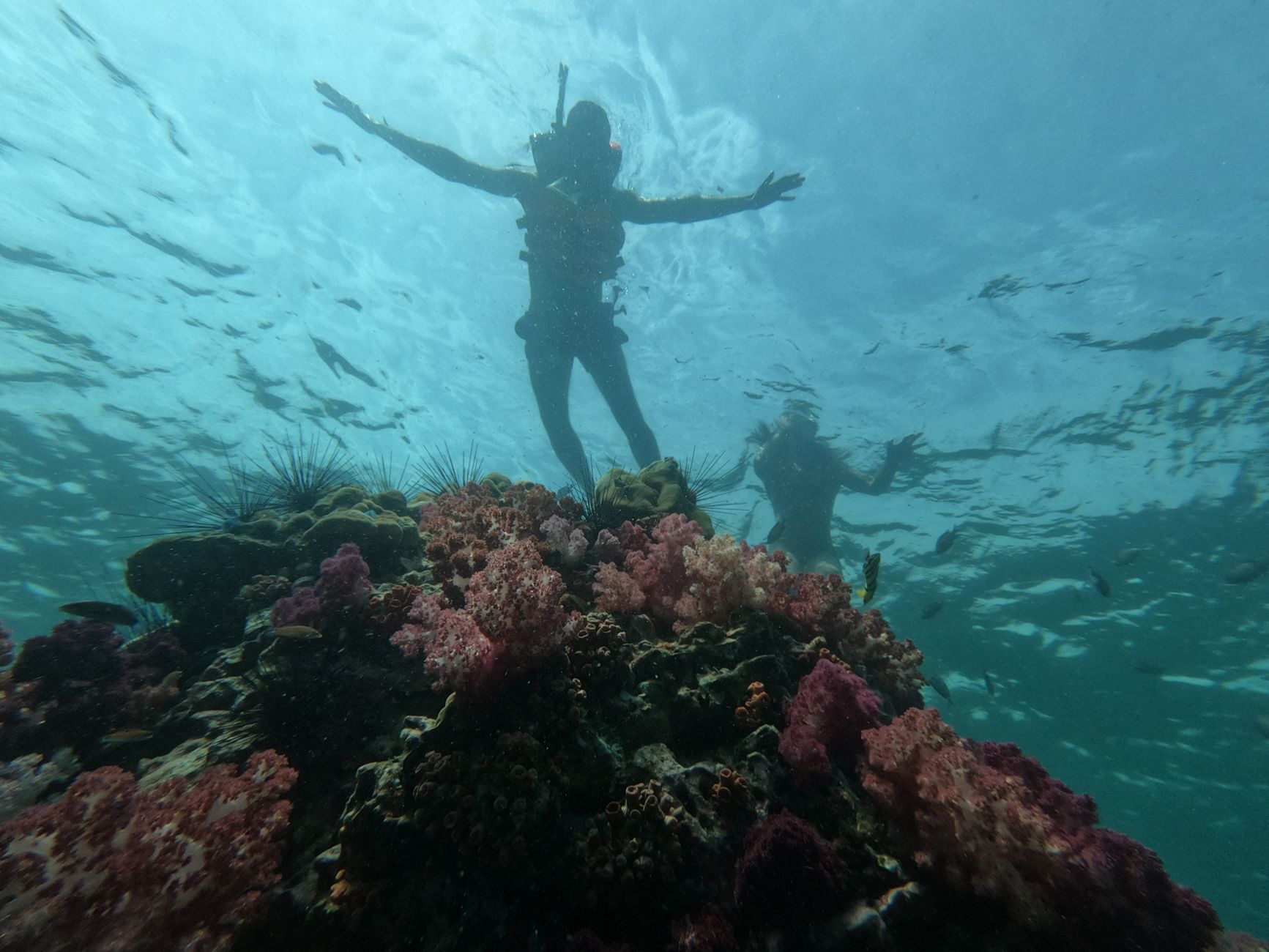
The Modern DPV Revolution: Effortless Cruising vs. Wildlife Ethics
Over the past five years, underwater propulsion technology has undergone a profound transformation. Bulky, lead-acid Diver Propulsion Vehicles (DPVs) weighing upwards of 20 kilograms—once the exclusive domain of deep-wreck and technical cave scuba divers—have been superseded by ultralight, hydrodynamically sculpted lithium-ion sea scooters. Weighing between 2.5 and 4.5 kilograms, modern sea scooters fit neatly inside a standard carry-on backpack, generate up to 12 kilograms of thrust, and pull a fully equipped snorkeler through the water at speeds up to 2.0 meters per second (4.5 mph).
For ocean snorkelers and marine expedition travelers, the appeal is undeniable:
- Effortless Current Management: Overcoming stubborn tidal currents and long channel crossings to reach outer barrier reef walls without calf cramps or physical exhaustion.
- Elimination of Surface Thrashing: Replacing noisy, turbulent fin-kicking with smooth, laminar water displacement, allowing observers to maintain perfectly stable, horizontal trim at the surface.
- Expanded Search Radius: Quadrupling the geographic territory a snorkeler can survey across expansive seagrass meadows (Thalassia testudinum) within a single 45-minute tidal window.
- Ultra-Stable Video Stabilization: Providing a rock-solid, two-handed motorized platform for 4K action cameras (GoPro and camera rigs ), eliminating camera shake caused by fin strokes.
       CONVENTIONAL SNORKELING                     DPV MOTORIZED CRUISING
 ┌───────────────────────────────────┐       ┌───────────────────────────────────┐
 │ • Rapid fin-kicking & splashing   │       │ • Zero fin agitation / silent glide│
 │ • High physical cardiac exertion  │  vs   │ • Conserved lung volume & stamina │
 │ • Limited 300m lagoon coverage    │       │ • 1,500m+ reef survey radius      │
 │ • Turbulent wake startles fauna   │       │ • Steady two-handed camera rig    │
 └───────────────────────────────────┘       └───────────────────────────────────┘
However, harnessing motorized propulsion in the presence of sensitive marine megafauna introduces serious ecological and biological responsibilities. Wild sea turtles—whether grazing Green turtles (Chelonia mydas) , spongivorous Hawksbills (Eretmochelys imbricata) , or massive pelagic Loggerheads (Caretta caretta) —are finely tuned acoustic creatures. Misusing an electric sea scooter by buzzing propeller blades near an animal or actively chasing a swimming reptile turns a revolutionary exploration tool into an instrument of severe wildlife harassment.
To use a sea scooter ethically and effectively, expedition snorkelers must master three core disciplines: marine reptile bioacoustics, the Zero Chasing Protocol , and international civil aviation battery logistics.
Sea Turtle Bioacoustics: How Marine Reptiles Hear Underwater
To understand why motorized sea scooters require strict operational discipline around sea turtles, one must understand how chelonians perceive sound underwater. Unlike terrestrial mammals, sea turtles possess no external ear flaps (pinnae) or open ear canals. Instead, their auditory anatomy is specialized for detecting low-frequency acoustic vibrations and pressure waves transmitted through the dense marine medium.
                  ANATOMICAL CUTAWAY: SEA TURTLE AUDITORY SYSTEM

                    [ Thick Cutaneous Scale / Skin Plate ]
                                     │
                                     ▼
                    [ Subcutaneous Fatty / Adipose Layer ]
                                     │ (Acoustic Impedance Match)
                                     ▼
                    [ Extracolumella & Bony Columella (Stapes) ]
                                     │ (Mechanical Vibration Transfer)
                                     ▼
                    [ Fluid-Filled Tympanic Cavity / Middle Ear ]
                                     │
                                     ▼
                    [ Inner Ear Cochlea / Hair Cell Receptors ]
                                     │
                                     ▼
                    [ Auditory Nerve to Brainstem ]
1. The Auditory Anatomy of Cheloniidae
The sea turtle’s ear is located immediately posterior to the eye, covered by a modified, elastic cutaneous scale that acts as a cutaneous tympanic membrane. Beneath this scale lies a specialized, thick subcutaneous lipid (fat) pad. This fatty tissue possesses an acoustic impedance closely matching that of seawater, allowing acoustic pressure waves to pass seamlessly from the ocean into the turtle’s head with minimal energy reflection.
These sound waves strike the columella (a slender, rod-like middle ear bone homologous to the mammalian stapes). The columella vibrates, transmitting sound energy across the fluid-filled tympanic cavity directly into the sensory hair cells of the inner ear (cochlea), which convert the mechanical vibrations into neural impulses routed to the brainstem.
2. Auditory Frequency Range & Peak Sensitivity
Extensive electrophysiological research—utilizing Auditory Evoked Potentials (AEP)—reveals that sea turtles operate within a narrow, low-frequency acoustic window:
- Auditory Spectrum: 50 Hz to 1,200 Hz. Sound frequencies above 1,200 Hz are virtually imperceptible to sea turtles.
- Peak Hearing Sensitivity: 100 Hz to 400 Hz, with maximum acoustic sensitivity concentrated between 200 Hz and 300 Hz (hearing thresholds dropping as low as 80–90 dB re 1 µPa).
 10 Hz            100 Hz            400 Hz           1,000 Hz          5,000 Hz        20,000 Hz
 ───┼────────────────┼─────────────────┼────────────────┼─────────────────┼────────────────┼──►
    │   [ INFRASOUND ]  │  [ TURTLE HEARING RANGE ]   │                │   [ HUMAN RANGE ]
    │                │  (Peak: 100 - 400 Hz)        │                │
    │                └──────────────────────────────┘                │
    │                                                                │
    │                     [ DPV BRUSHLESS MOTOR WHINE ]              │
    │                     (Fundamental: 150 - 600 Hz)                │
    │                     ░░░░░░░░░░░░░░░░░░░░░░░░░░░                │
3. The Acoustic Signature of Electric Sea Scooters
Standard electric sea scooters utilize high-RPM (revolutions per minute) brushless DC electric motors driving miniature dual or single propellers enclosed in ducted nozzles. At full throttle, these propulsion units generate two distinct sound profiles:
- Mechanical & Motor Harmonics: Brushless motor stator switching and electromagnetic whine produce fundamental acoustic spikes between 150 Hz and 600 Hz—falling squarely inside the turtle’s peak auditory sensitivity band.
- Propeller Blade-Pass Frequency & Cavitation: Rapidly spinning propeller blades create micro-vortices and turbulent pressure fluctuations that register as distinct, rhythmic low-frequency pulses underwater.
Because sound travels through seawater at approximately 1,500 meters per second—roughly 4.5 times faster than in air—with negligible acoustic attenuation in shallow reef flats, an accelerating sea scooter produces a sudden, directional acoustic shockwave that a grazing sea turtle detects long before the snorkeler comes into visual range.
       ACOUSTIC PROPAGATION: MOTOR ON vs. SILENT GLIDE

 [MOTOR AT FULL THROTTLE]
  DPV ())) ) ) ) ) ) ) ) ) ) ──► [Acoustic Shockwave 150-600Hz] ──► 🐢 [PANIC RESPONSE]
  (Propeller wash & mechanical whine)                                  • Heart rate spikes (Tachycardia)
                                                                       • Feeding terminated abruptly
                                                                       • Emergency panic surfacing

 [MOTOR CUT AT 10 METERS]
  DPV ── ── ── [Inertial Silent Glide] ── ── ──► (0 dB Noise) ──► 🐢 [CALM FORAGING]
  (Laminar, undisturbed water displacement)                            • Continuous seagrass grazing
                                                                       • Natural 15-min breath cycle
4. Physiological Trauma: The Danger of “Emergency Surfacing”
When a sea turtle experiences a sudden, high-intensity acoustic pulse from an approaching motorized propeller, its evolutionary predator-avoidance mechanism is triggered. In the wild, sudden low-frequency thrashing mimics the acoustic signature of an attacking Tiger Shark (Galeocerdo cuvier) or Killer Whale (Orcinus orca).
This induces immediate physiological and behavioral trauma:
- Acute Tachycardia & Energy Depletion: The turtle’s heart rate spikes, instantly burning stored oxygen reserves that would otherwise support a 20-to-45-minute foraging dive.
- Immediate Abandonment of Foraging: The turtle ceases cropping nutrient-dense seagrass shoots (Thalassia testudinum) and bolts across the reef flats in panic.
- The Peril of Emergency Surfacing (Rapid Ascents): Most dangerously, an acoustic shock frequently forces the turtle into an emergency rapid ascent. Sea turtles require calm, measured ascents to regulate gas exchange in their vascularized lungs and to visually scan the sea surface for predatory threats, speeding boat hulls, and commercial fishing gear. A turtle rocketing to the surface in a blind panic is at catastrophic risk of catastrophic boat-strike trauma, fractured carapaces from speeding skiffs, or fatal propeller strikes.
The Zero Chasing Protocol: Ethical DPV Code of Conduct
Operating a sea scooter in proximity to wild sea turtles requires unyielding adherence to the Zero Chasing Protocol. This operational doctrine guarantees that the DPV is utilized purely as an energy-efficient transit vehicle across barren sand channels and open water, never as an active pursuit craft.
                            THE ZERO CHASING PROTOCOL

     [ APPROACH ZONE ]              [ THE GLIDE ZONE ]             [ STANDOFF BUFFER ]
    (Distance: >15 meters)         (Distance: 15m to 5m)          (Distance: 5 meters)

 ┌────────────────────────┐      ┌────────────────────────┐     ┌────────────────────────┐
 │ • Motor at ECO Speed   │ ───► │ • THROTTLE COMPLETELY  │ ──► │ • ZERO PROPULSION      │
 │ • Smooth linear path   │      │   RELEASED (0 dB)      │     │ • Natural drift only   │
 │ • No abrupt steering   │      │ • Silent Inertial Glide│     │ • 5m minimum standoff  │
 │ • Visual acquisition   │      │ • Neutral trim hold    │     │ • Clear vertical path  │
 └────────────────────────┘      └────────────────────────┘     └────────────────────────┘
1. The 10-Meter Throttle Cut & Coast Protocol
The cardinal rule of motorized snorkeling: Never power a sea scooter within 10 meters (33 feet) of a sea turtle.
- As soon as you spot a turtle foraging on the seabed or resting on a coral head, immediately release the dual magnetic triggers.
- Allow your forward momentum to transition into a silent, inertial glide. By cutting the motor completely, ambient acoustic emissions instantly drop to 0 dB, allowing you to drift past or near the turtle as silently as a piece of drifting driftwood.
2. The 5-Meter Standoff Distance (The Motorized Buffer)
While standard unmotorized snorkeling guidelines under NOAA Fisheries Marine Life Viewing Guidelines typically recommend a 3-meter (10-foot) buffer, DPV operators must enforce a strict 5-meter (16.5-foot) minimum standoff distance. The physical bulk of a handheld scooter, combined with residual water displacement from the ducted nozzle, creates an intimidating visual footprint. Always maintain a generous 5-meter perimeter.
3. Preserving the 45-Degree Surfacing Trajectory
Sea turtles are air-breathing reptiles with non-collapsible lungs. When a turtle finishes a feeding cycle on the seabed, it ascends toward the surface at a gentle 45-degree angle to take 2 to 3 deep breaths before descending.
- Never hover or motor directly above a turtle.
- Never cross into the animal’s projected 45-degree ascent corridor.
- If a turtle initiates an ascent toward your sector, immediately maneuver backward using gentle, slow fin sculling—never activate the DPV throttle to back away, as the sudden motor whine directly above the turtle will trigger disorientation and panic.
                                  SURFACE
 ~~~~~~~~~~~~~~~~~~~~~~~~~~~~~~~~~~~▲~~~~~~~~~~~~~~~~~~~~~~~~~~~~~~~~~~~~~~~~~~~~~~~
                                    │
                                   /  <-- 45° ASCENT TRAJECTORY
                                  /       (KEEP COMPLETELY CLEAR!)
                                 /
    🐢 [Grazing Turtle]        /
   ═════════════════════════════════════════════════════════════════════════════════
   SEABED / CORAL REEF FLAT
4. Side-Gliding vs. Tailgating
Never follow directly behind a swimming sea turtle (tailgating). In the marine environment, direct trailing is the universal signature of an apex predator lining up an attack vector.
- Always position yourself to the side and slightly behind (flanking position at a 45-degree angle), maintaining visual contact while keeping a broad, open escape corridor for the turtle.
- If the turtle changes heading to swim away from you, let it go. Never activate the scooter to chase or pace a swimming turtle.
5. Propeller Guard Integrity & Seagrass Protection
All marine-certified sea scooters must feature heavy-duty, protective safety grilles over both the intake and exhaust ports of the propeller nozzles. These grilles serve two critical ecological purposes:
- Preventing accidental contact with curious marine life, flippers, or snorkeler fingers.
- Preventing loose fragments of Thalassia seagrass or floating macroalgae (Sargassum) from being sucked into the high-RPM impeller, which causes motor jams and shreds sensitive vegetation.
Flying with a Sea Scooter: FAA & IATA Lithium Battery Masterclass
Transporting a motorized sea scooter on domestic and international commercial flights requires navigating strict civil aviation safety protocols. Because modern sea scooters are powered by high-capacity lithium-ion (Li-ion) battery packs, they are governed by the International Air Transport Association (IATA) Dangerous Goods Regulations (DGR) and the US Federal Aviation Administration (FAA) Title 49 CFR.
                   LITHIUM BATTERY CAPACITY FLIGHT REGULATIONS

    CAPACITY (Wh)          AIRLINE STATUS                   CHECKED BAGGAGE?
 ┌──────────────────┐  ┌───────────────────────────────┐  ┌──────────────────┐
 │ ≤ 100 Wh         │  │ Carry-On ALLOWED              │  │ STRICTLY         │
 │ (No permit)      │  │ (No airline pre-approval req) │  │ PROHIBITED       │
 ├──────────────────┤  ├───────────────────────────────┤  ├──────────────────┤
 │ 100.1 - 160 Wh   │  │ Carry-On ALLOWED WITH APPROVAL│  │ STRICTLY         │
 │ (With permit)    │  │ (Max 2 spare units per pax)   │  │ PROHIBITED       │
 ├──────────────────┤  ├───────────────────────────────┤  ├──────────────────┤
 │ > 160 Wh         │  │ STRICTLY BANNED on Passenger  │  │ STRICTLY         │
 │ (Commercial DGR) │  │ Aircraft (Cargo freight only) │  │ PROHIBITED       │
 └──────────────────┘  └───────────────────────────────┘  └──────────────────┘
1. The 100 Watt-Hour (Wh) Hard Rule
- Under 100 Wh: Lithium-ion battery packs rated at 100 Watt-hours (Wh) or less are universally permitted in carry-on baggage aboard commercial passenger aircraft. Passengers may carry an unlimited (or reasonable personal-use) quantity of under-100 Wh batteries without requiring special airline approval.
- 100.1 Wh to 160 Wh: Battery packs within this bracket (e.g., the Sublue Mix Pro 122 Wh or Yamaha Seawing II 148 Wh) are permitted in carry-on baggage ONLY with prior airline authorization. Passengers are restricted to a maximum of two (2) spare batteries per person. You must contact your airline’s dangerous goods desk or customer support 48–72 hours prior to departure to register the batteries.
- Over 160 Wh: Batteries exceeding 160 Wh cannot be transported on passenger aircraft under any circumstances and must be shipped via certified Class 9 hazardous cargo freight.
2. How to Calculate Battery Watt-Hours (Wh)
If your sea scooter battery label only lists Voltage (V) and Ampere-hours (Ah) or Milliampere-hours (mAh), calculate the Watt-hour rating using this standard formula:
$$\text{Watt-Hours (Wh)} = \text{Voltage (V)} \times \text{Capacity (Ah)}$$
$$\text{If capacity is in mAh:} \quad \text{Wh} = \text{Voltage (V)} \times \left( \frac{\text{Capacity (mAh)}}{1000} \right)$$
Example: A battery rated at 22.2 Volts and 4,400 mAh (4.4 Ah) yields: $$22.2\text{ V} \times 4.4\text{ Ah} = 97.68\text{ Wh} \quad \text{(Under 100 Wh — 100% Airline Compliant)}$$
3. The Absolute Ban on Checked Luggage
               AIRPORT TRAVEL PACKING WORKFLOW FOR SEA SCOOTERS

  ┌───────────────────────────────────────────┐    ┌───────────────────────────────────────────┐
  │         CHECKED SUITCASE / DUFFEL         │    │             CARRY-ON BACKPACK             │
  ├───────────────────────────────────────────┤    ├───────────────────────────────────────────┤
  │ • Sea scooter chassis / hull (dry)        │    │ • Detached Li-ion battery pack            │
  │ • Removable buoyancy floater pod          │    │ • Terminals taped with electrical tape    │
  │ • Dual charger dock & AC power cords      │    │ • Enclosed inside fireproof LiPo safety bag│
  │ • Action camera mounts, lanyards, tools   │    │ • Printed UN38.3 & MSDS certificate sheet │
  │ • Mask, snorkel, [UPF 50+ rashguard](/gear/upf-50-rashguards-and-snorkel-vests/), fins          │    │ • DPV user manual showing Wh rating       │
  └───────────────────────────────────────────┘    └───────────────────────────────────────────┘
4. Essential TSA & Airport Security Travel Protocols
- Terminal Insulation: Cover the battery contact gold pins with heavy-duty non-conductive electrical tape or install the manufacturer’s supplied silicone terminal caps to prevent accidental short circuits.
- Fireproof LiPo Bags: Store each detached battery inside an individual fiberglass-woven, fireproof LiPo safety pouch.
- Carry Documentation: Print the official UN38.3 Test Summary and Material Safety Data Sheet (MSDS) provided by the manufacturer. Keep a copy in your carry-on bag alongside the DPV product manual clearly highlighting the Wh rating to show security screeners.
Detailed Field Reviews: The 4 Best Sea Scooters of 2026
We field-tested the top four consumer underwater Diver Propulsion Vehicles across shallow Caribbean seagrass lagoons, Red Sea reef drop-offs, and Indo-Pacific coral gardens to evaluate their real-world battery endurance, acoustic profile, hydrodynamics, and wildlife suitability.
   SUBLUE WHITESKARK MIX PRO       YAMAHA SEAWING II         GENEINNO S1 TRIDENT         SCUBAJET PRO MODULAR
 ┌───────────────────────────┐ ┌───────────────────────────┐ ┌───────────────────────────┐ ┌───────────────────────────┐
 │ • Dual-motor, 1.8 m/s     │ │ • Aircraft wing chassis   │ │ • Heavy-duty 12kg thrust  │ │ • 360° Enclosed waterjet  │
 │ • 122 Wh airline-safe bat │ │ • Integrated 5" OLED dash │ │ • 50m commercial depth    │ │ • Stackable 100 Wh modules│
 │ • Smartphone / GoPro base │ │ • 8.0 km/h (5.0 mph)      │ │ • Dual-speed 3.6 / 6.5km/h│ │ • Zero external blades    │
 │ • Weight: 3.55 kg (7.8lb) │ │ • Weight: 3.7 kg (8.1 lb) │ │ │ • Weight: 3.8 kg (8.4 lb) │ │ • Weight: 3.7 kg (8.1 lb) │
 └───────────────────────────┘ └───────────────────────────┘ └───────────────────────────┘ └───────────────────────────┘
1. Sublue WhiteShark Mix Pro: The Gold Standard for Travel Snorkelers
The Sublue WhiteShark Mix Pro represents the pinnacle of compact, dual-propeller engineering, making it the most popular and versatile sea scooter for international turtle expeditions.
       SUBLUE WHITESKARK MIX PRO - SCHEMATIC

          [ Removable Buoyancy Floater ]
       ┌─────────────────────────────────┐
  (L) [Motor]  ─── [Center Console] ───  [Motor] (R)
       │    │      │ GoPro Mount │      │    │
       │    │      │ Smartphone  │      │    │
       └────┘      └─────────────┘      └────┘
     [Intake Grid]  [122Wh Battery]   [Intake Grid]
Key Technical Specifications
- Propulsion System: Symmetrical dual brushless DC motors with ducted safety nozzles.
- Top Speed: Dual-speed modes — Low Gear at 1.2 m/s (2.7 mph); High Gear at 1.8 m/s (4.02 mph).
- Battery Architecture: 122 Watt-hour (22.2V, 5,500 mAh) high-density lithium-ion pack (detachable).
- Runtime: Up to 60 minutes in continuous low-speed mode; 25–30 minutes under aggressive high-speed usage.
- Depth Rating: 40 meters (131 feet).
- Weight (with Battery & Float): 3.55 kg (7.8 lbs).
- Camera Integration: Standard 1/4-inch tripod screw base for action cameras (GoPro/DJI), plus an included waterproof smartphone housing mount.
Field Performance & Turtle Snorkeling Assessment
In open-water lagoon tests across Akumal and Maui, the Mix Pro distinguished itself with its modular buoyancy architecture. With the top buoyancy floater pod attached, the scooter exhibits slight positive buoyancy; if you release the dual triggers to photograph a resting turtle, the scooter gently floats to the surface rather than sinking onto fragile coral. Removing the float pod creates neutral buoyancy, allowing snorkelers to duck-dive effortlessly to 3 meters.
The dual magnetic throttle triggers require both hands to be engaged simultaneously—a vital safety feature that prevents accidental motor starts. Acoustic testing recorded a relatively smooth, high-pitched motor profile that attenuates quickly beyond 10 meters, making the “Pulse and Glide” protocol exceptionally smooth.
- Pros: Ultra-compact footprint fits in carry-on backpacks; rapid 2-hour fast charger; dual camera mounting positions; detachable float pod for customizable buoyancy.
- Cons: The standard 122 Wh battery falls into the 100–160 Wh bracket (requires airline notification); high-speed mode drains battery rapidly in strong head currents.
2. Yamaha Seawing II: The High-Tech Hydrodynamic Cruiser
Engineered in partnership with marine robotics specialists, the Yamaha Seawing II features a futuristic, aircraft-inspired hydrofoil contour designed to minimize water drag and maximize swimming efficiency.
       YAMAHA SEAWING II - ERGONOMIC PROFILE

       ┌─────────────────────────────────────┐
       │     [ Integrated 5-Inch OLED ]      │
       │   Gear: 2 │ Batt: 85% │ Depth: 2.1m │
       ├─────────────────────────────────────┤
   (◄) [Pistol Grip]                     [Pistol Grip] (►)
       │ (Throttle)                       (Throttle) │
       └─────────────────────────────────────┘
        [Twin High-Velocity Counter-Rotating Props]
Key Technical Specifications
- Propulsion System: Contoured dual-thruster configuration with hydrodynamic winglets.
- Top Speed: 2-speed transmission — Low Gear: 5.0 km/h (3.1 mph); High Gear: 8.0 km/h (5.0 mph).
- Battery Architecture: 148 Watt-hour (22.2V, 6,700 mAh) sealed lithium-ion battery.
- Runtime: Up to 40 minutes of active cruising time.
- Depth Rating: 30 meters (100 feet).
- Weight (with Battery): 3.7 kg (8.15 lbs).
- Display Interface: Full-color OLED telemetry display mounted between the hand grips.
Field Performance & Turtle Snorkeling Assessment
The standout feature of the Yamaha Seawing II is its central OLED telemetry dashboard. While hovering over a coral drop-off, the screen provides real-time readouts of current gear selection, exact remaining battery percentage (eliminating guesswork), and live depth tracking.
The Seawing II is naturally neutral in saltwater, floating horizontally when unpowered. Its hydrodynamic wing design acts as an underwater stabilizer, allowing you to bank smoothly into sweeping, wide-radius turns around reef pinnacles without disturbing the bottom sediment. The throttle acceleration curve is soft and linear, preventing abrupt acoustic shocks when engaging low gear.
- Pros: Crystal-clear OLED battery and depth dashboard; sleek hydrofoil design reduces arm fatigue; superior high-speed sprint capability (8 km/h).
- Cons: The 148 Wh battery sits near the upper legal limit for carry-on aviation (requires airline approval); fixed buoyancy cannot be modified for positive float; slightly heavier frame.
3. Geneinno S1 Trident: The Heavy-Duty Deep-Reef Workhorse
For travelers who split their time equally between shallow reef snorkeling with turtles and deep free-diving or scuba expeditions, the Geneinno S1 Trident is built like an aquatic tank.
       GENEINNO S1 TRIDENT - HIGH-THRUST PLATFORM

         ┌─────────────────────────────────┐
         │     [ Heavy-Duty Alloy Frame ]  │
    ┌────┴────┐                       ┌────┴────┐
    │ Motor 1 │ ─── [Child Safety] ── │ Motor 2 │
    │ 6kg Th. │     [Lock Switch ]    │ 6kg Th. │
    └─────────┘                       └─────────┘
      [ 12 kg (26.5 lbs) Total Combined Thrust ]
Key Technical Specifications
- Propulsion System: Dual high-torque brushless motors producing 12 kg (26.5 lbs) of combined thrust.
- Top Speed: 2-speed throttle — Low Speed: 3.6 km/h (2.2 mph); High Speed: 6.5 km/h (4.0 mph).
- Battery Architecture: 140 Watt-hour (24V, 6,000 mAh) removable lithium pack.
- Runtime: Up to 45 minutes continuous operation.
- Depth Rating: 50 meters (164 feet) — commercial dive certification standard.
- Weight (with Battery): 3.8 kg (8.4 lbs).
- Safety Features: Hardware child-safety lock switch; positive buoyancy recovery float.
Field Performance & Turtle Snorkeling Assessment
The Geneinno S1 Trident delivers raw pulling power. With 12 kg of thrust, it pulls adult swimmers wearing heavy rashguards, weight belts, and long freediving fins through ocean chop with zero deceleration. Its 50-meter depth rating ensures structural reliability against hydrostatic pressure on deep wall dives where Loggerheads and Hawksbills rest in coral caverns.
The S1 features a physical safety lock beneath the chassis, preventing accidental throttle activation while climbing aboard inflatable Zodiac tenders or wading through surf zones. When unpowered, the Trident has positive buoyancy, floating to the surface if dropped.
- Pros: Incredible 12 kg thrust for battling offshore tidal rip currents; commercial-grade 50m depth rating; rugged corrosion-resistant materials; dependable child lock.
- Cons: Bulkier chassis requires larger carry-on luggage space; 140 Wh battery requires airline registration; slightly louder low-frequency motor rumble than the Sublue Mix Pro.
4. Scubajet Pro Modular: The Ultimate Enclosed Jet Propulsion System
The Austrian-engineered Scubajet Pro Modular is the undisputed Rolls-Royce of marine propulsion vehicles. Departing from traditional exposed propeller nozzles, the Scubajet utilizes a patented, fully enclosed 360-degree hydrodynamic waterjet impeller system.
       SCUBAJET PRO MODULAR - WATERJET ARCHITECTURE

   [ Smart OLED ] ──► [ Stackable 100Wh ] ──► [ Stackable 100Wh ] ──► [ 360° Enclosed ]
   [ Nose Console]    [ Battery Module 1]     [ Battery Module 2]     [ Waterjet Jet  ]
                                                                      [ (Zero Blades) ]
Key Technical Specifications
- Propulsion Architecture: Enclosed high-efficiency 360-degree waterjet impeller (zero external blades).
- Top Speed: Stepless variable speed control up to 2.0 m/s (4.47 mph / 7.2 km/h).
- Battery Modularity: Patented Smart Plug-and-Play Battery Modules (100 Wh each).
- Runtime: Up to 1.5 to 2.0 hours in dual-battery configuration (200 Wh total).
- Depth Rating: 60 meters (196 feet).
- Weight: 3.7 kg (8.15 lbs) in twin-module configuration.
- Multi-Sport Adaptability: Converts into a motorized SUP (stand-up paddleboard) fin, kayak motor, or scuba tank-mounted DPV via quick-release adapters.
Field Performance & Turtle Snorkeling Assessment
For turtle conservationists and marine biologists, the Scubajet Pro is the gold standard. Because its propulsion relies on an internal enclosed waterjet, there are zero spinning external propeller blades. It is physically impossible for loose seagrass (Thalassia), marine vegetation, or curious wildlife flippers to become entangled in the drive mechanism.
Furthermore, its modular 100 Wh battery system completely solves the airline regulatory dilemma. The battery compartment unscrews into two independent, airline-compliant 100 Wh modules. Each module is 100% legal for carry-on transport on any commercial airline worldwide without requiring prior airline notification. The smart nose console features an interactive OLED screen, and the stepless trigger allows you to micro-adjust your cruising speed to perfectly match ambient water flow.
- Pros: Enclosed waterjet eliminates all blade entanglement risks; stackable 100 Wh airline-compliant battery modules; supreme 60m depth rating; multi-sport conversion for SUPs and kayaks; stepless throttle precision.
- Cons: Premium price point ($1,800–$2,400+ USD); single-tube cylindrical layout requires two-handed grip balance; heavier than bare-bones dual-prop units.
2026 Sea Scooter Technical Comparison Matrix
The following benchmark comparison contrasts the core specifications, airline compliance ratings, propulsion architectures, and pricing across the top four underwater DPVs:
| Feature / Metric | Sublue WhiteShark Mix Pro | Yamaha Seawing II | Geneinno S1 Trident | Scubajet Pro Modular |
|---|---|---|---|---|
| MSRP Benchmark (USD) | $599 – $699 | $799 – $899 | $649 – $749 | $1,890 – $2,390 |
| Top Speed | 1.8 m/s (4.02 mph) | 2.2 m/s (5.0 mph) | 1.8 m/s (4.0 mph) | 2.0 m/s (4.47 mph) |
| Thrust Output | 8.0 kg (17.6 lbs) | 8.5 kg (18.7 lbs) | 12.0 kg (26.5 lbs) | 9.0 kg (20.0 lbs) |
| Max Depth Rating | 40 meters (131 ft) | 30 meters (100 ft) | 50 meters (164 ft) | 60 meters (196 ft) |
| Battery Wh Rating | 122 Wh (Standard) | 148 Wh | 140 Wh | 200 Wh (2x 100 Wh Modules) |
| Airline Carry-On Status | Approval Req. (122 Wh) | Approval Req. (148 Wh) | Approval Req. (140 Wh) | 100% Unrestricted (100 Wh units) |
| Max Battery Runtime | 60 minutes (Eco) | 40 minutes | 45 minutes | 90–120 minutes |
| Propulsion Type | Dual Ducted Props | Dual Hydrofoil Props | Dual Ducted Props | Enclosed Waterjet Impeller |
| Buoyancy Profile | Positive (Float) / Neutral | Neutral (Saltwater) | Positive (Safety Float) | Neutral / Modular Float |
| Integrated Display | LED Battery Bar | 5" OLED Screen | LED Battery Status | Smart OLED Nose Cone |
| Weight with Battery | 3.55 kg (7.8 lbs) | 3.70 kg (8.15 lbs) | 3.80 kg (8.4 lbs) | 3.70 kg (8.15 lbs) |
| Seagrass Entanglement Risk | Low (Ducted Grille) | Low (Ducted Grille) | Low (Ducted Grille) | Zero (Internal Jet) |
| Action Camera Mounts | Dual (GoPro + Phone) | Single Top Bracket | Dual (Top & Bottom) | Integrated GoPro Nose Cap |
Expedition Maintenance: Saltwater Care & Lithium Longevity
Saltwater is an unforgiving environment. Marine salt crystals, dissolved calcium carbonate, and fine coral sand will degrade electric motor seals and corrode gold battery pins if not properly maintained after every excursion.
                  POST-DIVE 4-STEP MAINTENANCE PROTOCOL

 ┌──────────────────────┐      ┌──────────────────────┐      ┌──────────────────────┐      ┌──────────────────────┐
 │ 1. FRESHWATER FLUSH  │ ───► │ 2. RUN UNDERWATER    │ ───► │ 3. DRY & INSPECT     │ ───► │ 4. SILICONE GREASE   │
 │ Soak in fresh bucket │      │ Spin motors 30s to   │      │ Microfiber towel-dry;│      │ Apply silicone paste │
 │ for 15-20 minutes    │      │ purge trapped salt   │      │ inspect O-ring seals │      │ to battery gold pins │
 └──────────────────────┘      └──────────────────────┘      └──────────────────────┘      └──────────────────────┘
- The 20-Minute Freshwater Immersion: Never simply spray a sea scooter with a garden hose. Fill a clean tub or bucket with fresh water and submerge the entire unit for 15 to 20 minutes. This allows freshwater to dissolve microscopic salt crystals hiding inside the motor bearings and propeller duct crevices.
- Post-Soak Motor Purge: While submerged in clean freshwater, activate the dual throttles in low gear for 30 seconds. The rotating water flow forces out trapped sand grains, seaweed fibers, and silt.
- O-Ring Maintenance & Inspection: Remove the battery pack only after the outer chassis is completely towel-dried with a microfiber cloth. Inspect the rubber sealing O-rings around the battery chamber. Clean any sand grains using a lint-free swab, and apply a thin film of 100% pure food-grade silicone grease to maintain watertight elasticity.
- Off-Season Storage State of Charge (SoC): Never store lithium-ion DPV batteries at 100% full charge or completely empty (0%). If you are storing your sea scooter for several months between expeditions, discharge or charge the battery to 40%–60% capacity (approx. 3.8V per cell) and store it in a cool, dry room (15°C–22°C / 59°F–72°F) inside a fireproof LiPo safety bag.
Diver Propulsion Vehicles vs. Marine Reserve Sanctuary Laws
Before launching a motorized sea scooter at any world-class turtle snorkeling destination, you must verify the local marine protected area (MPA) regulations. Because unregulated motorized watercraft can disrupt wildlife behavior and create congestion, several premier sanctuaries have enacted specific statutory policies regarding DPVs:
                      GLOBAL DPV MARINE SANCTUARY COMPLIANCE

 ┌───────────────────────────────────────────┐    ┌───────────────────────────────────────────┐
 │       PERMITTED (WITH ETHICAL RULES)      │    │     STRICTLY PROHIBITED FOR TOURISTS      │
 ├───────────────────────────────────────────┤    ├───────────────────────────────────────────┤
 │ • Hawaii Open Coastal Waters (DLNR/DAR)   │    │ • Akumal Bay Protected Polygon (CONANP)   │
 │ • Barbados Carlisle Bay Marine Park       │    │ • Galápagos National Park (PNG / Ecuador) │
 │ • Maldives Resort House Reefs (Private)   │    │ • Ningaloo Marine Park Sanctuary Zones    │
 │ • Red Sea Coastal Fringes (Marsa Alam)    │    │ • Fernando de Noronha Marine Park (Brazil)│
 └───────────────────────────────────────────┘    └───────────────────────────────────────────┘
- Akumal Bay (Mexico - CONANP Sanctuary): Motorized diver propulsion vehicles of all types are strictly illegal within the buoyed turtle conservation polygon under Mexican Federal Standard NOM-059-SEMARNAT-2010. Only certified guided swimming with mandatory flotation lifejackets is permitted.
- Galapagos National Park (Ecuador): Recreational motorized scooters are completely banned for tourist use to prevent disruption to marine iguanas and Green sea turtles.
- Hawaii Coastal Waters (USA - DLNR/DAR): DPVs are legal in public open-ocean waters outside designated restricted swim zones (e.g., prohibited inside Hanauma Bay nature preserve). Operators must maintain the statutory 10-foot (3-meter) federal buffer from all Honu (Green turtles) under the Endangered Species Act.
- Maldives Atolls: Most private island resorts permit handheld electric sea scooters on outer house reefs and drop-offs, provided swimmers follow guided reef safety briefings and stay off shallow lagoon coral flats.